EPS consists of a simple, well-defined polymer structure and is flame-retardant, meaning you cannot ignite it with a lighter. However, if EPS is exposed to intense flames and heat exceeding 200 °C, it first melts and then burns even above its flash point of 200 °C. However, due to its simple molecular cell structure, the smoke gases produced are far less toxic than those from burning ordinary wood.
Burning EPS does not produce dioxins; the heavy black soot is caused by carbon atoms, which are then released as soot.
Euroclass E – flame-retardant
In terms of the structural requirements for the MAGU wall system, our Neopor is classified as ‚E‘ according to DIN EN 13501-1—meaning that our Neopor has been tested and classified as flame-retardant.
In practice, Neopor is always either plastered over or covered with drywall. These coverings usually meet the REI 30 requirements, meaning they can withstand direct exposure to fire for more than 30 minutes before being destroyed.
In the event of a house or room fire, the thermal insulation is initially protected behind the plaster. If the outer layers are exposed to direct flame for more than 30 minutes at a temperature exceeding 200°C, the flame will eventually reach the Neopor and ignite it. By that point, the entire contents of the house would already have been completely burned, and all occupants would hopefully be safe in the fresh air outside.
Fire bars – for added safety
In response to the alarming images of burning facades on high-rise buildings, the German Institute for Building Technology has introduced measures to prevent fire from spreading through the thermal insulation. An analysis of these terrible events had revealed that, in one case, the facade was still under construction—meaning the exterior plaster had not yet been applied—and that in the two other cases from France and England, the insulation materials were not quality-controlled and certified in accordance with our DIN EN 13501 standard, since the buildings had been insulated as early as the 1960s and 1970s.
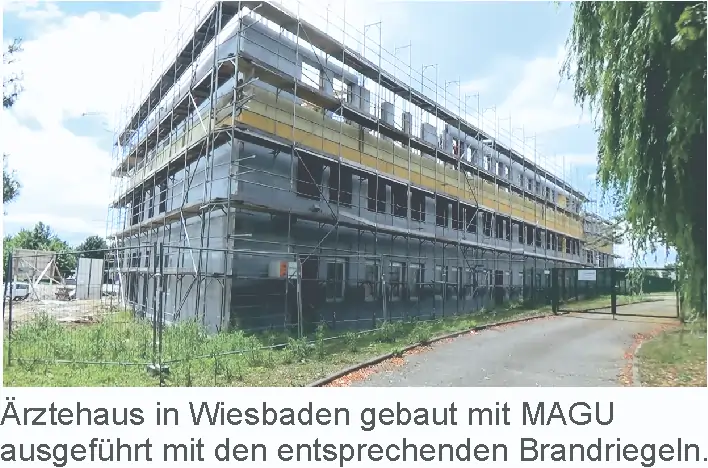
Nevertheless, for several years now, Class 4 and 5 buildings—that is, those with a facade height of more than 7 meters—have required the installation of a fire barrier made of non-combustible material on every other floor, which provides additional safety.
The discussion so far has focused on the insulation material, but not on the actual load-bearing structure. The load-bearing structure consists of solid concrete, which, at a thickness of 140 mm, is rated REI 90 in accordance with EN 13501; this means that the concrete core can withstand direct exposure to fire for at least 90 minutes and thus meets the requirements for a fire wall.
Thanks to the solid wall construction, the structural stability of the MAGU house is never at risk—and it remains stable even under the worst conditions.